Thursday, April 28, 2011

Pitfalls of being the mother of a cricket fan

In all my daydreams about my little sonny growing up, I never imagined this particular pitfall. 

Riju is a cricket fan. Fair enough, in the country of Sachin. I'm a bit of a follower, too. Problem is, Riju is an IPL fanatic and his Team are the Kolkata Knight Riders. This is the franchise's 4th year and all three previous years, KKR has been at the bottom of the table. One would've thought that was enough to put one off KKR, but not my son. He's still very much a KKR person. And therein lies my problem.

Every time the Knights play, I must play the paramedic-cum-counsellor role. Comforting a traumatised pre-teen while predicting bright futures and hiding away the breakables surreptitiously is no mean task, mind you. And the bunch of losers make my task even more difficult. This year, just when things were going smoothly with three wins in a row, they had to go and lose the next two games. Pall of gloom at home, immediately.

These days, my mornings are spent crystal-ball gazing. Newspapers arrive; Riju's the first one to get to them; and then the dreaded announcement, made in a tone befitting the calamity: "KKR has slipped down one more place on the League table."
"Have they, dear?"
"Today, if the Royal Challengers win, they'll slip further down." [Voice nearly inaudible]
"Don't worry, honey, KKR won't slip further." [As if!]
"You sure, Mum-mum?" [Heart-breakingly hopeful]
"Of course! They'll play the Semis this year, I tell you." [They'd better!]
"Then, they can't lose a single game from now on..." [slight note of disbelief]
"And they won't." I close the argument with Nostradamus-like flourish, and send up a little prayer myself.

All through this conversation, I'm aware that the moment KKR lose another tie (and that's often enough, believe me!), Riju will turn on me furiously, holding me to my prophecy. And apart from cursing my stupidity, I'll have no way out. Try explaining to a fan that sports is all about participating (as opposed to, winning), and you'll know why I do what I do. Those hopeful eyes, clinging to every single word of my wild prophecy, just make it seem so right at that moment. Never mind my surging blood pressure the next game night.

Friday, July 10, 2009

The Censorship Tightrope

I've realised something. Parenting does not get simpler, as one would expect, as your child grows older. It gets more and more complicated and convoluted. Take the issue of censorship, for example.

As a modern-day 'liberated' parent, you recoil from the very mention of the C word. An individual should be exposed to all kinds of things. If you raise a child sensibly, then he or she should be able to sieve the good from the ugly. In keeping with this philosophy, I have never changed television channels when a snogging scene comes up, nor have I stopped Riju from watching Hindi mainstream films. My books are also unlocked and accessible. I believe that adult content implies subjects that a young mind may misinterpret, not necessarily sex and violence that society at large brands as "adult".

But, of late, my belief is wavering. The most recent trigger is a game. I have, in the course of Net trawling and conversations with knowledgeable persons, heard of a famous and addictive game called the Grand Theft Auto. Riju was exposed to this game on a visit to his cousin's. He was completely enthralled and wanted to buy it, with his own pocket money. "Okay," I agreed.

He bought Grand Theft Auto: San Andreas on a recent visit to a mall. On our way home, I was looking at the purchase when I saw that there's "18" written on the cover. Now, why would a PC game be only for adults? I glanced through the booklet that came with the package, and discovered, to my consternation, that the game features, apart from the usual mayhem and murders, foul language in the conversations between the characters, a gay bar that a player can frequent and a strip club full of friendly neighbourhood strippers. And, I found out later, the cheat codes for the game include one that allows a player to have sex.

Whoa! Now that was too much even for me. When I pointed out that this game is meant for people older than 9 definitely, Riju protested loudly. Anybody would; after all, it was his money he spent on the game. He offered to let me play it to see for myself how harmless it is. I couldn't turn that down. I played. And I did not come across anything that could be labelled 18-and-above. So, I let Riju play while I hovered in the background. It seemed innocuous enough. But even then, after he was through for the evening, I locked the game CD in my wardrobe. I haven't given it to him yet, coming up with one excuse or the other.

But sooner, rather than later, I have to give it to him. I can't really ask him to wait till 18, can I? And I also can't keep a watch all the time. So, I'm in a fix. Should I let him play GTA at the risk of seeing him spout foul language and harbouring not-so-innocent thoughts at the tender age of nine? Or should I clamp "Parental Discretion Rule" ignoring my son's protests and my earlier anti-censorship philosophy? Do I protect his innocence or preserve his individuality? Aaargh!

Monday, May 04, 2009

Kids and Consumerism

I wrote this piece over 4 years ago. But the point's still valid.

Raising a child in these times of rocketing consumerism is fraught with danger. One constantly hears stories of youngsters barely into their teens using rather crooked means to get their quota of cell phones, designer outfits, nightclub entries and what have you.

Doctors and social scientists advise us parents not to give in to our children’s demands, but that, like most pieces of advice, is easier said than done. I know. I have a four-year-old who loves his cartoons, but he loves the ads in between the cartoons even better. He doesn’t mind if he misses a minute or two of his favourite Popeye or Tom & Jerry show, but hell breaks loose if we mute the television even for a second during the commercials.

Last Christmas, he asked Santa for a washing machine—not just any, mind you, but of a particular brand—so that his mother, like the ever-smiling super mom in the ad, can have enough time on her hands to bake him a strawberry cake. That his mother doesn’t even know the recipe to begin with, or that even if she did, she would hardly have had the time or the energy (ask any mother, the phrase ‘energy crisis’ holds an entirely different meaning for them) to bake a cake after a hard day’s work seems to have escaped him completely. Luckily for me, Santa didn’t oblige. And I got him a strawberry pastry from the neighbourhood cake shop.

But I don’t expect all problems to come with such simple solutions. There’s a whole wide world of goodies out there, and it’s only a matter of time before he starts eyeing the pricier ones. Therein lies the crux of the problem: How do I explain to a four-year-old that all those nice toys lining the shop window doesn’t really matter in the bigger scheme of things; that he should focus on the smaller (read: cheaper) joys of life; that abstinence is the best policy to reach a higher plane of being? The explanation becomes even tougher in the light of the fact that his parents simply can’t do without their share of the latest gadgets, good clothes, and premium Scotch. We know, of course, that, we are well past the age when we are likely to give in to temptations like clearing out our parents’ bank accounts (we drain our life’s savings instead, but that’s another story), but it’s difficult making that distinction to my son. Consumerism is here to stay, and all we parents can do is pray that we don’t get our throats slit for refusing a camera phone. As of now, my son’s fifth birthday is coming up and he has asked for a house.

Thursday, April 30, 2009

All that Fan-Fare

Riju is now old enough to be a fan. A cricket fan. It started, though, with being a Shah Rukh fan. Last year IPL. Shah Rukh in town, doling out sound bites on his team, the Kolkata Knight Riders. Riju had just turned eight then. He was not really interested in cricket. Computer games like Need for Speed were more up his street. Like most children these days, sport, to him, meant a period in school. He had a football at home: deflated and neglected. His father cajoled him to watch soccer ties with him: to no avail. Formula 1 drew more attention.

So this was the situation when Shah Rukh came to town. Riju knew all about 'SRK', as he called the star. His movies are fun and had great songs. And boy, could he dance! SRK's team was a natural choice for Riju. The 8-year-old began watching cricket. Learned the names of the players, learned names of strokes, a few fielding positions and bowling actions. Listened to adult conversation and tried to copy. That was last year.

Then, he wanted a bat, balls, wickets. A playing companion. The last one was the toughest. But even that got sorted out eventually, sporadically. He began to shadow practise. He followed even normal cricket matches and the careers of his team players. Some players were gradually elevated to favourites' spot. He got himself a computer game on cricket and cheered when he learned the trick to hit a sixer.

And now, this year's IPL. Riju saved up to buy the Knight Riders jersey. From Reebok, no less. I winced on seeing the price tag, but then I was never a fan. Not like this. I cheered for India too, especially in Prudential Cup. I shed tears when Sachin got out, but secretly. I prayed for Ivan Lendl to win the Wimbledon and Graf the French Open. I lusted after Gary Linekar and, of course, Klinsmann and Maradona. But I never got myself jerseys: merchandising had not yet become so widespread. And I never become so caught up with team's fortune that I would want to dump that same jersey after my team lost consecutive matches.

Watching a KKR match with Riju has become fraught with danger. As the team miserably lurches from one loss to the next, the 9-year-old howls, sobs, whimpers, throws tantrums and anything around him. No amount of explaining that it's only a game does the trick. It's then that I feel the resentment welling up inside me. Resentment against the team management, coach, owner and the players. All of them. If only they could see how their mismanagement and ego tussles cause so much pain and misery to a single fan — a child who, innocent of the ways of the world, had reposed all his faith in his hero's team. If only they could see how they fail him and countless others like him who dreamt of a trophy. If only they realised how they are making cynics of nine-year-olds.

The IPL introduced my son to the charms of cricket. Would the same IPL make him turn away from the sport? Would the fan'fare' die or would it mature into love? Watch this space to know.

A Small Verse

In Bangla.

Mon kharap brishti holo eto

Shomosto raat mathaar charidharey

Ami tomar swapney pawa angul

Joriye chhilam jwoler adhikarey

Thursday, October 30, 2008

'Banned' Wagon

The country-wide smoking ban is nearly a month old. But no uprisings yet. Not even a candle-light protest vigil. Rights continue to get trampled in this world. Smokers are humans too. Humans with a different perspective: we will all die one day. Yes, you too, you non-smoking, non-guzzling, non-non-organic-food-hogging, non-lethargic fitness freak. We smokers just deal with it better.

Still, every time we feel the urge, we need to make our way down office buildings, adorned with paan stains in every corner, to the sun-soaked, rain-drenched roadside. That's what a smoke means these days: braving the weather, the stares of regressive men, and the traffic.

Even the Friday night tipple has to go without its accompanying smoke rings. How can a sane person drink without taking a drag from time to time? How can the interesting argument on the future of Indian cricket without the Big Three be carried on without cigarettes? What kind of one-dimensional character devised this form of cruelty? What's next? A ban on liquor? A clamp on adda? A prohibitionary order on a party?

For many of us, cigarettes are a friend. Yes, the friend demands its pound of flesh, but do you really think friendships are without give-and-take? A cigarette comforts us in grief, supports us in times of trouble, joins us in happier moments, relieves us when we are tense and anxious. It helps us overcome that awkward pause on conversation, strike up a conversation with that good-looking stranger...

Smoking helps us feel at one with the world. For however long we are in it.

Monday, September 29, 2008

Nostalgia Trip

This morning I listened to Mahishasurmardini after about 12 years. I heard it last in 1995, just before landing my first job in The Telegraph. Night shifts for five years thereafter ensured that I got out of the habit of getting up at 4 am to listen to Birendra Krishna Bhadra's baritone. And I got married to someone who was never really into Mahishasurmardini to begin with. So, even when I had eased into regular work hours following Riju's arrival, rising early on Mahalaya was never on the agenda for me.

It wasn't this year too. But, somehow last night I set the alarm for 4 am, instead of 6.30. And this morning, somehow I actually remembered why I set the alarm and plugged in the headset.

To me, Mahishasurmardini is associated with travel. My father has always favoured travelling in autumn when the weather's great and you can escape the Calcutta crowds. Never one for pandal-hopping, I loved spending the Pujas away from the chaos. So, Mahalaya meant packing bags and airing woollens. It meant helping ma make luchi and alur dam for dinner on train. It meant buying toothpastes and splitting hairs on which clothes to take and which to leave behind. Mahalaya meant anticipation. It still does, but in a different way.

Growing up in central Calcutta, I've never had any para friends to spend the Pujas with. When we were younger, ma used to whisk us away to her parents' place on those rare vacations when we were not travelling. Spending the holidays with cousins was fun, but it stopped us — my brother and myself — from getting to know any children in our locality. In high school and college, when, like my cousins, I became busy with studies, Puja evenings would be spent on our verandah, gazing at the gay parade of pandal-hoppers: families, lovers, children. And then, from 1995 onwards, I worked through the Pujas and cursed the crowd as I wearily made my way home well after midnight.

The picture didn't quite change after marriage, as both my husband and I continued to work on the four days. Then, as I began to forge tentative friendships with Dhiman's para friends, adda (with booze) sessions were planned on the Puja evenings. These proved a great success and are now a regular Puja feature. Something I wouldn't miss for the world. Travelling can wait till after Dashami. So, Mahalaya now means I need to stock up on munchies and alcohol. And plan.

Today, I listened to Mahishasurmardini with my son. It was his first time. And, wonder of wonders, he liked it. No. Come to think of it, it isn't really a wonder. Birendra Krishna Bhadra's evocative early-morning chants spell exactly the same thing for him as they do for millions of Bengalis and Calcuttans — anticipation.

Friday, July 04, 2008

I have discovered poetry. A friend needs to be credited for this. He read me a few of Sunil Ganguly's poems, and got me hooked, not only to Bengali, but to all kinds of verses.

Not that I was a complete newcomer to poetry. From my schooldays, I remember Eliot's Macavity (the Mystery Cat), Nissim Ezekiel's Night of the Scorpion, excerpts from Madhusudan Dutt's Meghnadbadh Kabya. In high school, I lapped up Tagore's "Shesher Kabita", a must for any poetry connoisseur. Tagore's translation of Donne was as memorable as the lyrical love story of Amit and Labanya. But what I liked, and memorised, especially was the last poem, "Kaaler jatrar dhwani shunitey ki pao..." In college, I switched loyalties to Premendra Mitra. His elegant prose I was acquainted with, but his poetry captured my heart. Briefly. The race to graduate honourably and get myself a job took precedence over the gentler form of literature.

After that, I could never find the time to read verses. It required a lot more patience, more time and space for introspection, which I did not have and could not afford. Then, after 13-odd years, poetry found me again.

Suddenly, I am reading poem after poem, buying anthologies, begging friends for that rare Pablo Neruda collection. Revelations follow revelations. Over the past three months, I have discovered that Sunil Ganguly's Neera poems are an exquisite ode to love, Shakti Chattopadhyay's "Jete pari..." tugs at your heartstrings, Sylvia Plath's quirky perspectives amaze you, while the intermingling of patriotism and passion in Pablo Neruda's verses fascinates you.

I confess. I have fallen in love again. With verse.

Thank you, friend.

Friday, April 18, 2008

Getting a child to read...
...as opposed to dragging him or her away from television.

Both Dhiman and I love to read. Books and magazines and newspapers and even brochures are strewn all over our home. We spend at least Rs 10,000 a year on books. But Riju's affinities still lie frustratingly with the television. And computer games. And remote-controlled cars.

Granted, he reads Tintin and newspapers. But I want him to devour Enchanted Woods, Famous Five, Adventurous Four, Jungle Book, Robinson Crusoe, Alice in Wonderland NOW. Why isn't he pouring over "Buro Angla", I wonder bitterly. Or, "Raj Kahini". But however much I advertise the cause for reading, my son still favours television shows. And I don't want to overdo this — it might turn him totally against reading.

The temptation to compare his childhood with our's is huge. We had read most Enid Blytons by his age, also some of the classics. Bengali books, too, were devoured at a great rate. But the comparison is unfair, really. The little television we had comprised mostly of once a week evening shows of Charlie Chaplin or Godzilla. Or, some years later, Johnny Soko and the Flying Robot and Diff'rent Strokes. Would we have read as much if we had the Cartoon Channel, or POGO or Nickelodeon vying for our attention? Probably not.

So what's the solution? Any suggestions?

Thursday, March 06, 2008

Dear Mr Sandip Ray,

I am writing to you on behalf of all Satyajit Ray fans. After watching your latest film, Kailashey Kelenkari, I have a request to make. Please do not make any more Feluda movies. We love the stories your father wrote, especially those involving the sleuth and his cousin. So we cannot bear the vandalisation of these evergreen characters on celluloid. We cannot bear to see a pot-bellied and heavy-jowled Feluda, a pompous brat of a Topshe, and a silly Jatayu. It goes against our grain to accept a movie where Feluda's deduction abilities are largely left to the audience's imagination, where Jatayu is ridiculously excited about an ad shoot, where Topshey is so condescending towards Jatayu that one winces.

While we adore Sonar Kella and Joy Baba Felunath, we completely understand your father's decision not to make any more Feluda movies after Santosh Dutta's untimely death. Filling such a great void would always be difficult, and subsequent attempts by thespians such as Robi Ghosh, Anup Kumar, and Mohan Agashe proved that. Now, your experiments with Bibhu has touched the nadir of characterisation. Jatayu, as seen in SK and JBF, was a celebrity in his own right, not inferior to Felu or Topshe, nor a mere comic relief. That is how your father conceptualised him. But the Jatayu in your films, especially in Kailashey Kelenkari, is nothing more than a joker, a buffoon to be laughed at. That's a gross misreading of the character, Mr Ray (Junior).

Another instance is that of Topshe. Why is a 27-year-old man playing the role of a 15-year-old boy? A young-looking 21-year-old is still acceptable, but we refuse to accept the pretentious and pompous Parambrata as Topshe. He is not Topshe. Never.

We like Sabyasachi. We really do. We still remember the strapping young man of Tero Parbon who was such a change from the Abhisheks and Prosenjits. And he does fill Feluda's shoes quite nicely. Rather, he did. Sabyasachi no longer looks suitable to play Prodosh Mitter. Just take a look at any of illustrations your father made for his Feluda books and you will understand why. Feluda would never have a pot-belly, however small, or heavy jowls, like the ones Sabyasachi sported in Kailashey Kelenkari.

I will not even go into the stilted dialogues or the completely awry characterisation throughout the movie. If the three main draws of a Feluda film are such flops, the rest do not hold much attraction. Get real, Mr Ray (Junior), you are just not equipped to carry your father's legacy forward. It must be stressful trying to live up to your father's reputation as a film-maker, so just give it up. No one will miss it. I swear.

You must be earning enough from the copyrights of your father's books. Just put some of the money in a sound investment scheme and take voluntary retirement. Buy yourself a nice vacation in Darjeeling and throw away all those half-finished scripts into a deep gorge. Or into a fireplace. Leave Feluda alone. And Goopy-Bagha too. They deserve it.

Yours (really) sincerely...

Tuesday, May 15, 2007

...and so, we meet again

Yes, it's been a long time. Over six months. Not that I've had nothing to say all this time, but time crunch and lethargy together played spoilsport.

I was thinking the other day of the Bengali soul. The soul that comes alive this time of the year, courtesy the great guru's birthday. You start humming bard songs, and paras buzz with "cultural functions". Kolkata Doordarshan dusts and airs archival footage of Tagore anniversary celebrations from the last millennium (if the footage is not archival, the performers are), while the other pretenders, the new news channels on the block, play the TRP game with Rabindra psycho babble.

Yeah, yeah, I know. Overhyped and over the hill. That's what "Pnochishey Baisakh" has boiled down to. Look at those somnabulists droning one Bengali anthem after another, and you would know. Do any of them look like they care? A TV poll asked sweaty members of the audience, "which one of the following Tagore works were made into movies? (a) Charulata; (b) Hemanter Pakhi; (c) Chokher Bali; and (c) Noshtoneer" and a hilarious number of them got the answer wrong.

I remember a random survey by Kolkata Doordarshan's famous Pankaj Saha several years ago, where he roamed the streets of the city and asked people to recite at least one Tagore verse. Very few could remember a Tagore verse to begin with, and even fewer could recite a couple of lines correctly. What a letdown in a city that prides itself on its "cultural" heritage.

But then, it's inevitable. You cannot expect all Bengalis to rattle off Tagore at the drop of a hat, and the popularity of his songs are no measure of the depth of awareness about the poet. His songs are popular because by nature, songs are easier to absorb than an essay, or a verse in iambic tetrameter. Or a 500-page novel about a Hindu activist who finds out he's not a Hindu after all.

The Bengali soul, therefore, is not about knowing your bard by heart. It is the feeling that creeps in one baisakh evening, cooled by a sudden nor'wester, watching the raindrops drip from the window sill, letting your gaze linger on the scattered clouds on the horizon, smelling the wet jui in the fitful breeze. When you feel like expressing that weird sensation inside you, right then and there. When you feel like drawing up a pen and a paper and writing something, anything. When you feel like a poet. That, my friends, is the Bengali soul. Never felt like this? Well, pleased to meet you, Mr Jhunjhunwala!

Wednesday, October 18, 2006

Recently, Guardian published a piece by Julian Barnes, where he has changed the ending of Madame Bovary. Taking off from there, a journalist friend of mine has written in her weekly column that she would like to change the ending of Ramayana, where Sita refuses to undergo the trial by fire and leaves Ram instead.

That got me thinking. If we had the chance, the ending of which work of literature would we change? And why? Eric Segal's Love Story, in which Jenny would conquer her illness and the couple would live happily ever after? But would that be as memorable as it is now? Would Romeo and Juliet be as popular had they lived? Maybe, Juliet would find Romeo too impulsive and leave him after a year. Maybe Romeo would fall for Juliet's attractive cousin who has this thing for balcony romances.

What'll happen if Dr Zhivago left his wife to live with Lara? Humdrum exitence of everyday couples don't make for great literature. Unrequited love does. It arouses the sob-aholic in us, the eternal yearning (and sighing) for things beyond our reach.

After Scarlett O Hara lost Rhett Butler in Gone with the Wind, Alexandra Ripley tried to repair the injustice (so most of us thought) with Scarlett, the sequel. But while we had fervently prayed that Rhett would forgive Scarlett and return, what a damp squib that prayer turned out to be in writing. Scarlett was wish-fulfillment, but darn it! the book was so disappointing that we almost wished that we didn't wish!

So, friends, what books would you change the endings of? Would you like Robinson Crusoe never to return to civilised society, but build an alternate civilisation on the desert island? Would you prefer Mowgli to realise Shere Khan's plight and actually counsel Baloo and Bagheera on the importance of saving the tiger?

Do write in. This would make one helluva interesting never-ending story!

Friday, October 13, 2006

Some more photos from Berlin.

Here is Riju being a monkey in Berlin zoo. We made this trip on the day of the Finals. Predictably, despite it being a Sunday, the zoo (Tier Park) was largely empty. Spread over a huge area, the zoo tested our walking stamina alright. We missed the food counters and had to lunch on candies and cashew nuts.


At Checkpoint Charlie, the junction of the Russian-occupied and American-occupied Berlin. Riju is the archetypal American soldier, saluting Cap'n Mom. The cap was priced at 10 euros, so we handed it back to the shopkeeper after our shoot.


Riju and Dhiman in front of the Smart car. This 2-seater is an eye-candy all the way. And equally popular across at least 3 countries.

Wednesday, September 27, 2006

No. I didn't get to see even the shadow of Ballack or the team bus of Zidane while in Germany during the World Cup finals. But I did get to see the fans. And what a revelation that was. Fans in all shapes and sizes and race and gender... Noisy teens, couples in love, university students, husbands and wives, father with sons and daughters perched on their shoulders.

A continuous stream of people passed Riju and I as we lounged in front of the Brandenburg gate. People of all nationalities, their love for soccer overriding national pride. Brazilian supporters rooting for Italy, Germans cheering the French team. It didn't really matter. They were all actually shouting for soccer. It was amazing to watch so many true blue soccer fans congregated in one area.

And so many children among the fans. Boys and girls, even toddlers, with faces painted with country colours, waving flags and team scarves. Babies in prams, sleeping peacefully in the racket, while their parents swig beer by the gallon. It was all a great family outing: something to be enjoyed to the hilt.

It was all very novel for me: in India the soccer crowd comprises of men only. I have been to the Salt Lake stadium for a number of matches and never did I spot any woman in the teeming crowd. For the India-Japan match, there was a large number of women, but they were all Japanese supporters. Indian women clearly disapprove of football. Or, even if they do like it, they prefer the privacy of their drawing rooms to cheer their favourite team on. Very different from cricket, which draws a most glamorous crowd, with girls in tank tops and Indian colours painted on their faces (or on other body parts) vying for the roving television camera's attention.

I felt comfortable in Berlin. I was not the only mother in the fan area. It felt good to see women around you also asking their children to be patient, or taking out packets of sandwiches or biscuits to keep them contented. I think Riju liked it too with so many children around. Maybe the on-field action didn't hold his attention so much as the off-field one, but at least he didn't mind being part of a crowd. And being patient till his mom finished cheering for her team. Given that a soccer match is over in about 2 hours, the day-long enjoyment I witnessed in Berlin on July 9 truly proves that football is the world's favourite sport.

Tuesday, September 26, 2006

Contrary to all my fears, our (Riju and mine) journey to Berlin passed off without any major hitch. Kolkata to Dubai was hassle-free, of course. Three hours transit in the swanky Dubai airport was not so bad either. Duty-free tempted all the shopaholic genes in me, but thoughts of the next 15 days in foreign land on a shoestring budget kept me in check. Nonetheless, Riju wangled a promise to buy him a toy robot on the way back.

Dubai to Munich was mostly spent snoozing. When we landed in Munich, we were caught completely unawares by the daylight-at-9 pm characterestic of Europe. But we had an emigration to clear and a train (two, in fact, the second to Berlin) to catch and couldn't wonder long at the disconcerting sunlight.

Taking a quick glance at the worn paper with common German phrases written on it, I plunged into Germany. To my pleasant surprise, I saw that I can actually make do with the Queen's language, aided suitably with appropriate gestures.

The journey from the airport to the main station (Hauptbahnhof) was mostly incident-free, except an unexpected change of trains due to some problem on the tracks. A good samaritan helped me get on the right train thereafter. Here, let me add that I found Germans a friendly and helpful people. Definitely politer than the Parisians and Londoners. As I struggled with a heavy suitcase up a staircase (Riju having developed a sudden and temporary fear of the escalator), people actually carried it up for me, without so much as a sweat. They were always willing to help me find my way to some place or the other, always signing off with a smile. And they didn't mind that I could not speak a word of German except "Danke".

Catching the train to Berlin proved to be tougher. The train was scheduled at 11.55 pm. At a platform far from the main station. We squatted on our suitcase and watched as various other trains came and went and platforms around us emptied. At 11.30, I began to panic. For, there was no trace of our train yet. And the few Deutsch Bahn (kinda like Indian Railways) officials around at that hour simply shrugged when I mentioned the train number. The DB office was closed. I frantically raced, with Riju in toe, to the platforms at the other extreme which still had trains waiting.

For the umpteenth time, I showed the printout of my Internet ticket to a train conductor. He pointed to a train waiting in a completely different platform than was mentioned in the ticket. [Dhiman, more experienced in German ways, told me later that platform numbers are changed at the drop of a hat in Germany.] We got on to the train, got our ticket punched (was majorly scared that the Net version will not be accepted), and settled down for the long overnight journey ahead.

Lovely train. Very punctual. Clean loos. Noisy restaurant car next door. That was because of all the French and Italian fans drinking themselves silly on way to the finals.
Ok. Apologies to everyone. I had promised regular update from the Great European Tour, but had stopped after the very first post. Now it's past two months since we have returned. As they say, it's better late than never. And here let me start with a few photos of our Berlin trip.

The day before the Finals. The Fan Mile started from the Brandenburg Gate. The Football Globe in front toured the host nation before being dismantled in Berlin the day after the Finals. The Globe contained an exhibition on soccer and had as an exhibit the magnificent World Cup trophy. That's the closest I came to the much-coveted golden orb.


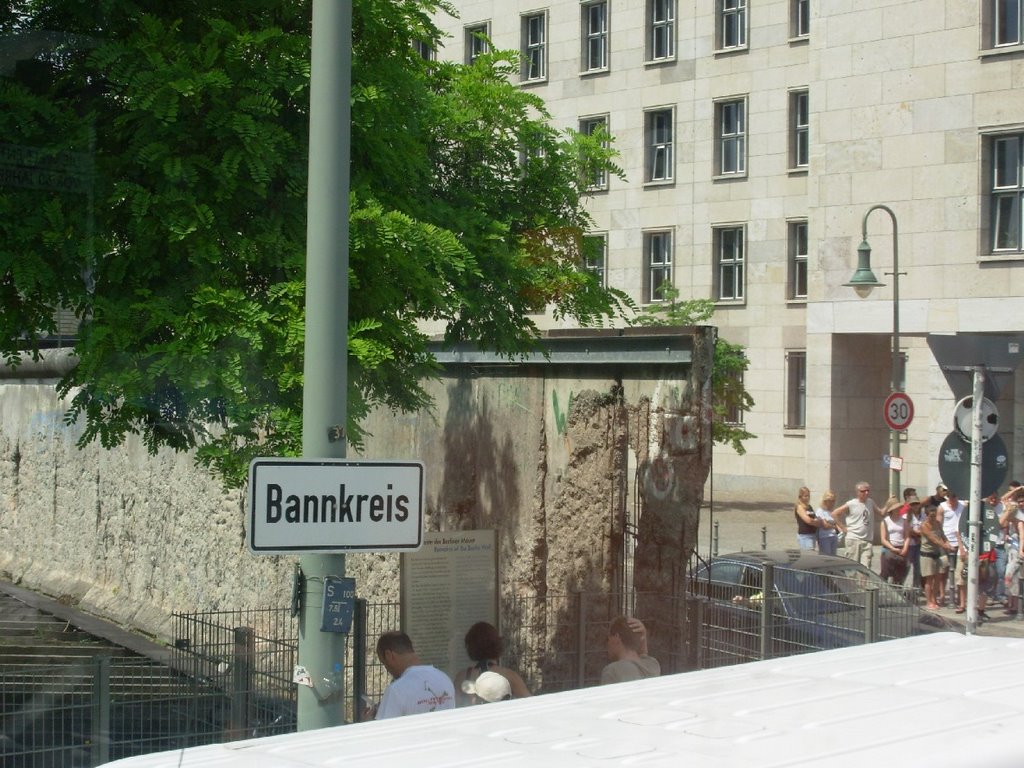
The Berlin Wall. Or, a section of it that still stands. Looks harmless enough, doesn't it?


The Olympiastadion at Berlin. The venue of the 2006 soccer finals. The hallowed ground that saw Zidane exit the match, shamed.

Monday, July 10, 2006

Berlin Diary 1

Ich bin ein Berliner. And that's about how far my german knowledge goes at the moment. But the German capital doesn't mind. Fussball (yes that's how they say football in this part of the world) transcends language and fans are always welcome in this city. Ronaldinho may have boiled down to a caricature on the streets, but many windows still sport the brazilian flag. It's all about the beautiful game, finally. No ill-feelings about Germany not being there in the finals? Not apparent, at least. As a good samaritan told me on the Munich U-Bahn station, "We are the good hosts... we let other countries win." Fair enough!

Interest in the cup had also not waned with Germany's exit. Over seven hundred thousand turned up on the fan mile in Berlin to watch the France-Italy clash. What an overwhelming experience that was. But, before I come to the finals, let me talk about the third place play-off which we watched as invitees to the media party, courtesy Dhiman of course! Sitting under the trees, swigging the 'official' beer (Anheuser Busch Bud) in the twilight and with plates heaped with sausages and sauerkraut (rather disappointing... pickled cabbage this!), we watched, surrounded by over a thousand media persons, Klinsmann's champs romp home with the third place trophy. The whole place erupted in joy and festivities were still on when we dragged ourselves to the hotel past 12 midnight. No photos though, I had forgotten my camera.

On the morning of the finals, Riju and I had gone visiting the Tierpark, or the zoo. Changing trains, asking for direction by gesticulating wildly, we reached there without any incidents. An exhauting four and a half hours later, we again boarded the U-Bahn to Alexanderplatz on our way to the hotel (near Pankow). We ran into groups of fans in the station... French fans laughing at their Italian counterparts, singing "It's easy to buy a referee in Italy" to a popular English tune (I've forgotten the words). The Italians seemed good-natured enough. They didn't mind the ribbings. Even as the game started, the French fans told the Italians, "Don't be too disappointed with the runner-up trophy. You've done good to come thus far." The Italians, of course, had the last laugh as Zidane's head-butt left the French shocked and in tears. It occurred to me as I watched the match that do they teach head-butting at Real Madrid? Figo did it, and now Zidane. Maybe Beckham would've done it too, if he had the chance!

That's all for now. Next post later. Photos will follows soon.

Tuesday, May 09, 2006

I'm a bit overwhelmed at the moment. My husband is going to cover the World Cup in Germany. And my son and I will be joining him there just before the finals. Now, I have travelled alone with Riju before, but never on such a long haul, never to a foreign country (I've never been to a foreign country to begin with, darn it!), and never for a sporting tournament. Will I manage to reach Berlin safely where I meet my husband? We are travelling on an Emirates flight to Munich. After a 3-hr stopover at Dubai (strictly inside the airport for us), we'll be reaching Munich at 8.55 pm and then will proceed to Berlin on train. It sounds awfully complicated to me and god alone knows, how Riju will take to it. I don't know a word in German except 'Auf Weidershen' and 'Third Reich' and 'blitzkrieg'... none very useful I guess. Neither do I know a thing about emigration proceedings and stuff... what exactly goes on there? Please someone, assure me that everything's gonna be fine!

Thursday, May 04, 2006

Last evening, I saw a film. Hotel Rwanda. It made me speechless.

The film, made in 2004 by Terry George, is set in Rwanda in 1994. It deals with the genocide stemming from the Hutu-Tutsi rivalry. I remember the clashes. I was working in The Telegraph then. I remember Joydeep, our foreign desk chief, getting agitated about the Hutu-Tutsi in-fighting and insisting on taking it on the foreign pages. We used to laugh about this then. Last evening, a line from the film, "They watch it (the carnage) on television, say 'My God', and then continue with their dinners", was like a slap across my conscience.

The film, based on a true story, is about Paul Rusesabagina (portrayed excellently by Don Cheadle), a manager at the Belgian-owned 4-star Hotel Des Milles Collines at Kigali. He is intelligent, suave, and resourceful, knowing exactly how to please his patrons. He is also a family man, with feet planted firmly in the grim reality, a man who's willing to go that extra mile, but only for his own kin. Initially, despite his wife's pleas, he refuses to be drawn into the ethnic friction because of a neighbour. Because he knows he risks his own loved ones then. But as the situation in the country spirals out of control, he finds himself sheltering, by hook or by crook, over a thousand persecuted Tutsis in the hotel. He averts a massacre almost every moment, yet lives with the realisation that he himself, along with his family and all those he sheltered, can be wiped out in one fell sweep.

The film invites comparison with Spielberg's Schindler's List. Here, too, is a man whose thoughts are as far removed from philanthropy as Oskar Schindler's. But here, too, he shows exemplary courage and humanity in rescuing the hunted. However, the holocaust unleashed by the Nazis are much, much better known and represented among the creative arts than the Rwandan genocide. Herein, lies the crucial difference between the two films. The Third World perspective, with the current Western powers refusing to intervene and stop the killing, is much more hard hitting than Poland during the second World War, with help from the Allied forces almost a shout away.

Hotel Rwanda was a harrowing experience. It was also a memorable experience. A film that everyone should see.


Friday, April 21, 2006

And this one's completely angst. I read in someone else's blog today that a recent study has found out that only 13 milliseconds are required to notice somebody attractive. Researchers found that people's reaction time to attractive faces were significantly faster than that of un-attractive faces. No wonder attractive people are likely to be more noticed, dated, hired, and promoted.

I'm doomed. But that's beside the point. Which is, does the research prove that it actually pays to get a tummy tuck, nose job, face lift etc etc? Is all that talk about being beautiful inside all bull, aimed at keeping the un-attractive happy? Are fairness lotions an investment after all, feminist rhetoric notwithstanding?